Hercule Poirot
The A.B.C. MurdersHercule Poirot is the Belgian detective at the centre of The ABC Murders, where the apparent pattern of alphabetically ordered killings conceals a separate murder and a calculated attempt to misdirect the police. His defining contribution is not simply to recognize a pattern but to question what that pattern is for: by treating the letters, the victims’ connections, and the suspect’s character as parts of one design, he identifies Franklin Clarke as the killer and Alexander Bonaparte Cust as a manipulated scapegoat.
Identity and Introduction
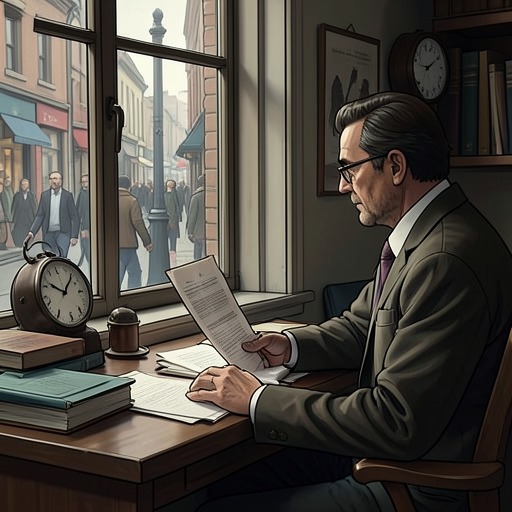
When Arthur Hastings returns to England from his ranch in South America in June 1935, one of his first acts is to visit his old friend Poirot. Poirot is living in a new service flat in London, selected partly for its pleasing geometry and symmetry. The orderly setting reflects a mind that values arrangement, though the investigation that follows repeatedly tests whether visible order reveals the truth or disguises it.
Poirot’s work proceeds through careful attention to details and an unwillingness to treat an impression as proof. When Hastings calls his concern about the first letter an instinct, Poirot rejects the word: it is knowledge and experience, he says, that tell him something about the letter is wrong. He also acknowledges the possibility of exaggerating a small matter, and, with no immediate action available, accepts that they must wait. This combination of suspicion and restraint distinguishes his method from mere hunch-taking.
The Letters and the Public Investigation
Poirot keeps his papers methodically docketed and pigeon-holed, so that he can retrieve the letter he wants without delay. The gesture is characteristic: physical order supports the comparison of evidence, but it does not substitute for interpretation. At a conference involving senior police officers and Dr Thompson, the authorities establish that two warning letters are in the same handwriting. Poirot, however, considers the postmark on the later letter—Hampstead—of little importance, resisting a detail that could distract from the substance of the case.
The investigation expands into a public spectacle. Scotland Yard believes extensive publicity offers the best chance of catching the murderer, and the country becomes, in effect, an army of amateur detectives. The Daily Flicker urges readers to think that the killer may be in their town; Poirot’s letters are published and facsimiled, and he is both blamed for failing to prevent the crimes and defended as a detective close to naming the murderer. The publicity makes the threat widely visible, but it also intensifies the public’s focus on the serial pattern that the killer has constructed.
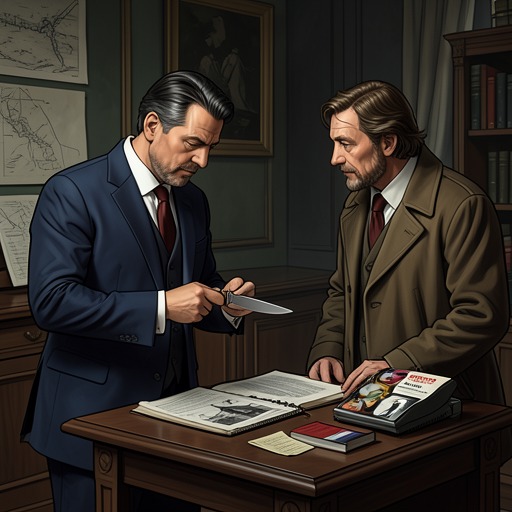
When the fourth letter arrives, Poirot opens it at once with a paper-knife and reads it with Hastings and their companion. It names Doncaster and September 11 as the location and date of the next “little incident,” while taunting the police and invoking the familiar instruction to try again. Inspector Crome responds with a large-scale plan: the press is to warn Doncaster, people whose names begin with D are to be alert, and police from across England are to be sent into the town. Poirot’s part in the case is set against this show of force: he understands that a warning can mobilize an entire population while still serving the criminal’s design.
Bringing Witnesses Together
A few days after Franklin Clarke proposes that those connected with the crimes pool their recollections, the group—called the “Special Legion”—meets in Poirot’s rooms. Poirot takes the place of a chairman at the head of the table. Hastings observes the assembled people anew: Thora Grey, Megan Barnard, and Mary Drower, as well as Franklin Clarke and Donald Fraser. The meeting gives Poirot a setting in which separate memories and impressions can be compared, rather than treated as isolated statements.
This approach underlies his confidence in conversation as an investigative instrument. He tells Hastings that, once he has obtained further information from the Special Legion and answered a particular question, he will confront A B C. He does not describe the encounter as a contest of physical force or a dramatic arrest: they will talk. Conversation, he argues, gives people an opportunity to express their personalities, and in doing so can disclose what they wish to conceal. For Poirot, listening is active work: a phrase or manner of speaking may expose the person behind a constructed explanation.
Reconstructing the Scheme
Poirot’s decisive insight is that the sequence of murders has been designed to conceal an individual crime within a series. A single murder attracts attention to the victim, the motive, and the people who had opportunity; one killing among several apparently related ones is harder to isolate. He likens the effect to a pin that is least noticeable in a pincushion. The letters and railway guide therefore function not only as clues to a supposed serial murderer but as a frame that directs attention away from the criminal’s personal stake in one of the deaths.
His review of the suspects shows how he tests motive and opportunity against temperament and circumstance. Franz Ascher appears a likely suspect in the Andover murder, but Poirot cannot reconcile him with the elaborate, premeditated design. Donald Fraser is a possibility in the Bexhill case because he is capable and methodical, but jealousy alone does not persuade Poirot that he planned the murder; Fraser’s early-August holiday also makes his involvement in the Churston crime unlikely. Those exclusions matter because they prevent the alphabetical pattern from dictating a single explanation for every killing.
At Churston, the inheritance provides a stronger motive. Sir Carmichael Clarke is immensely wealthy; his wife has a life interest in the estate, and the money will then pass to his brother Franklin. Poirot turns to Franklin as he identifies the connection between that financial consequence and the person he has been considering. The seemingly separate qualities he has noted—the adventurous, attractive, socially easy man, his roving life, methodical habits, and boyish tastes—now form a coherent portrait. Poirot concludes that Franklin Clarke is A B C, the writer of the letters and the murderer.
Proof and Narrative Significance
Poirot distinguishes the strength of a theory from the proof needed to establish it. He tells Clarke that, while nobody suspected him, he was safe; once suspicion fell on him, evidence could be obtained. The physical evidence includes a stick recovered from a cupboard at Combeside, its thick knob concealing a section of wood replaced with melted lead. Witnesses identify Clarke in places that contradict his account: two people pick his photograph from a group after seeing him leave the cinema while he was supposed to be at the Doncaster race-course, and Milly Higley and a girl from the Scarlet Runner Roadhouse identify him in connection with the evening Betty Barnard was taken there to dine. Most damagingly, Clarke’s fingerprint is on Cust’s typewriter—a machine he could not plausibly have handled if he were innocent.
The explanation completes Poirot’s reversal of the case’s apparent meaning. The alphabetical killings and warnings encourage police and public alike to search for a single serial murderer; Poirot recognizes that the pattern itself is a means of concealment, and that the person who seems to fit the theatrical public image of A B C is not the harmless, implicated Cust but Franklin Clarke, a participant with a motive rooted in inheritance. Poirot’s achievement lies in joining the broad pattern to the particular crime it was meant to hide, then grounding that reconstruction in material evidence rather than intuition alone.
Poirot’s prominence extends beyond the story’s events: a television adaptation of The ABC Murders, with David Suchet as Poirot, was first shown on London Weekend Television on 5 January 1992. Within the novel, meanwhile, a chapter is explicitly titled “Poirot Makes a Speech,” and the explanation of the case gives extended form to his characteristic practice: he turns observation into argument, reconstructing not only what happened but why the apparent logic of the crimes was meant to mislead.